

2026 marks a structural shift
By 2026, AI governance shifts from being a strategic ambition to a practical necessity. Regulations are tightening, standards are more clearly defined, and authorities expect organizations to show real evidence of action, not just plans.
Organizations now need to prove they have real control over their AI systems, rather than simply stating their intentions.
Around the world, supervision is becoming more hands-on, standards are designed to be auditable, and consulting firms are shifting their focus from just developing strategies to actually supporting implementation.
This urgency is even greater for Nordic organizations.
-
Denmark: NIS2 fully mandatory since July 2025
-
Sweden: NIS2 enforced from January 15, 2026
-
Finland: AI Act supervision active since January 1, 2026
-
Norway: AI Act implementation expected summer 2026
The Nordics face a unique situation, with major compliance requirements such as the AI Act, NIS2, GDPR, and ISO 42001 all taking effect simultaneously.
Yet, many organizations still approach these frameworks as separate systems, which only adds to costs and complexity. Since almost half of the requirements overlap, building a unified governance structure can help address all four frameworks at once.
1. The global landscape: Why 2026 is a turning point
Across the globe, technical standards, supervision models, and compliance deadlines are changing quickly.
ISO 42001
ISO 42001 is the first global standard focused on managing AI systems. Although it does not match the EU AI Act in every detail, it offers a solid foundation for defining roles, setting procedures, supporting continuous improvement, maintaining records, and establishing controls throughout the AI lifecycle.
prEN 18286
This quality management system is designed to support compliance with the EU AI Act. The public enquiry closed in December 2025, and publication is not expected until late 2026 at the earliest. When released, it will create a presumption of conformity for Article 17 .
NIST AI RMF 2.0
The NIST AI RMF 2.0 serves as a global reference for managing AI risks in practice and complements the ISO 42001 standard.
EU AI Act timeline and the Digital Omnibus reality
The Digital Omnibus from November 2025 proposes to extend high-risk AI deadlines to late 2027 and 2028. However, it has not yet been approved. If it is rejected by August 2026, the original deadlines will remain in place.
The bigger issue is not the changing deadlines, but the overall direction of regulatory developments.
Regulators now expect organizations to provide documented evidence of how their governance works in practice, rather than just more strategy documents.
-1.jpg?width=798&height=532&name=pexels-mart-production-7222979-2(3)-1.jpg)
2. The Nordic reality. Timelines and immediate action
High adoption, low readiness
Nordic companies are ahead in adopting AI, but their governance practices have not kept pace.
-
75 percent of Nordic CxOs integrate AI into most initiatives
-
Only 26 percent of CEOs are directly involved in AI strategy
-
53 percent cannot assign clear accountability
-
60 percent of construction firms use AI, but only 25 percent see impact
Even with high levels of AI adoption, most organisations are still not fully prepared to manage these systems effectively.
NIS2: Nordic’s non-negotiable starting point
NIS2 stands out as the main requirement that organizations need to address, and it is also the most likely to be enforced first.
It also directly overlaps with the EU AI Act:
Denmark: Full NIS2 compliance mandatory since July 1, 2025. Registration deadlines passed. Hybrid supervision model with centralized authority (SAMSIK) plus sector-specific regulators.
Finland: NIS2 fully implemented with seven sector-specific authorities. Administrative fines cannot be imposed on public entities, but private entities face full exposure.
Sweden: NIS2 Act enters force January 15, 2026. Must register 'as soon as possible' from this date. Unlike other Nordics, Sweden can impose fines on both public and private entities, and management may face time-limited prohibitions on holding management functions.
Norway: AI Act implementation targeted for summer 2026, with Norwegian Communications Authority (Nkom) as coordinating supervisory body.
Nordic organizations are approaching NIS2 and the AI Act as a unified compliance effort.
They are implementing controls that address both sets of requirements.
Organizations that take this integrated approach will move forward more quickly, while those that do not risk spending more on duplicate systems.
3. The regulatory overlap
If Nordic organizations treat NIS2, GDPR, the EU AI Act, and ISO 42001 as separate projects, they will create four distinct governance systems instead of one integrated framework. Since these frameworks share many requirements, it is important to assess the level of integration.
The following checklist can help:
0 - We operate in four silos with no integration.
1 - Some frameworks are partially integrated, but we still maintain key elements separately.
2 - Most compliance tasks are integrated across frameworks, but still face coordination challenges.
3 - Fully integrated governance system and infrastructure satisfying all frameworks.
Using this checklist can help organizations spot gaps and find areas where their approach can be improved.
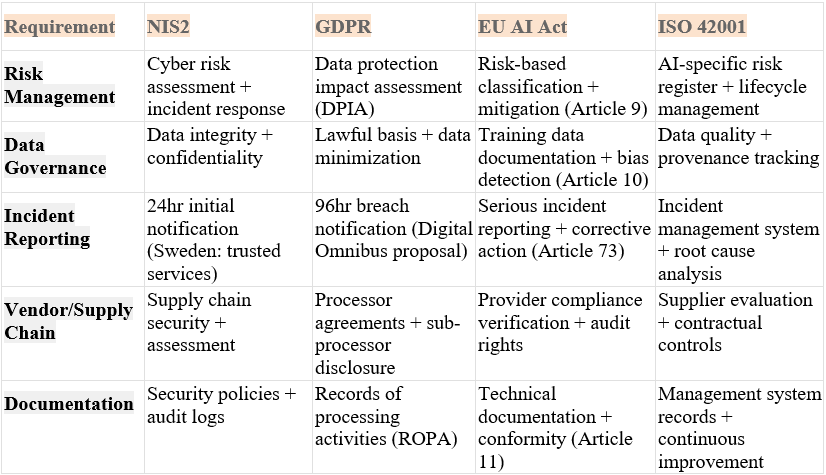
A single, integrated governance system can provide the evidence needed to satisfy all four frameworks. The Digital Omnibus is also proposing a unified entry point for incident notifications across NIS2, GDPR, DORA, eIDAS, and CER, which will harmonize templates and processes. Nordic businesses that start integrating their approaches now will be better positioned to gain a competitive edge as these changes come into effect.
4. What Nordic organizations should implement in Q1 2026
Now is the time to move past strategy and focus on implementing practical solutions.
1. Unified AI system inventory
One register covering risk tier, sector, data categories, supplier, purpose.
Covers NIS2 + GDPR + AI Act + ISO 42001.
2. Integrated incident response
One workflow.
Three triggers: cybersecurity incident, data breach, AI serious incident.
3. Combined risk assessment
One process addressing:
GDPR DPIA + AI Act fundamental rights + NIS2 cyber risks + ISO 42001 bias, accuracy and robustness.
4. Centralized vendor governance
One assessment covering:
GDPR DPAs + NIS2 supply chain +Nordic organizations will succeed by making execution their top priority.rdic organizations achieve success by prioritizing execution.
5. What changes across the Nordic region in 2026
Already active
-
Denmark: Full NIS2
-
Finland: AI Act supervision
-
GPAI transparency rules
Q1 2026
-
Sweden: NIS2 entry into force
-
Mandatory AI inventories
H1 2026
-
Norway: AI Act supervision begins
-
prEN 18286 expected to stabilise
H2 2026
-
AI Act high-risk requirements enter into force (unless extended)
-
Nordic enforcement intensifies across all sectors
The main takeaway is that, in 2026, organisations will need to provide clear, concrete evidence of how their business practices work in reality.
The Nordic advantage
Nordic organisations have structural benefits that others envy:
-
High digital literacy
-
Modern data infrastructure
-
Strong public trust
-
Long tradition of cross-sector collaboration
These strengths allow Nordic firms to move quickly. In 2025, they deployed AI solutions 20 percent faster than the European average. However, without the right structure, this speed can become a risk. To stay ahead, Nordic organisations should use their advantages to build integrated governance now, before enforcement picks up pace.
Final message
Nordic organisations are at a turning point:
Build one integrated governance system.
Otherwise, organisations could find themselves managing four separate programs, each adding to costs and complexity.
The decisions made in the first quarter of 2026 will shape how efficiently organisations can comply over the next three years.
Organizations that take action now will do more than just meet requirements.
They will compete.