

Authors: Anne Holst-Dyrnes and Olli Korpinen
A brief history of data consumption
For most organizations, data consumption has followed a couple of familiar patterns. In the first wave of BI, a question would arise in the business, and a request had to be submitted to a centralized IT team, which produced reports to deliver answers. This highly governed approach ensured control, but often led to slow turnaround times and a gap between technical teams and business needs.
To address these challenges, the second wave introduced analyst-driven, self-service BI. Business analysts, who possessed both technical and domain knowledge, were given tools and access to explore data and answer questions more directly, bringing insights closer to the business and increasing speed.
As usage grew, however, so did the need for consistency and governance. Responsibility gravitated back toward shared data models and specialized roles, creating new bottlenecks. Backlogs reappeared, and the business once again learned to moderate its questions.
As AI is becoming ubiquitous, this model is starting to change.
What AI actually adds
Development speed
AI accelerates development across the entire analytics lifecycle, from exploring data and generating queries, to building reports and iterating on them. Tasks that previously required manual SQL writing, data modeling, and multiple back-and-forth cycles can now be bootstrapped in minutes and refined interactively. This reduces the time from idea to implementation, making it possible to move from a question to a working artifact far faster than before.
Agent Skills for Power BI, part of Microsoft Fabric's latest release, is a practical example of this shift. An analyst can describe what they need in plain language and get a starting semantic model and report back. From there, it becomes iteration rather than construction. The cycle that previously required multiple people and several days of back-and-forth compresses significantly.
This isn’t just a productivity gain. Faster development means data teams can respond to business questions in near real-time and spend more of their capacity on analytical work that requires genuine expertise.
New surfaces alongside reports
Reports remain the governed, trusted core of data consumption, but they’re no longer the only way to reach data. AI makes it practical to expose the same governed data through different interfaces: a chatbot, a natural language query, or embedded directly in an operational workflow. A warehouse manager asking “Am I on track today?” doesn’t need to wait for a dashboard to be built, they can chat with their data and get an answer the moment they need it.
Building applications directly on a data platform, where the data lives, with governance already in place, has been an established pattern in parts of the data landscape for a while. The newly announced Fabric Apps and Rayfin brings app development into the Microsoft Fabric ecosystem. Teams working in Power BI and Fabric can now build and deploy applications on top of their existing semantic models and governed data, without stepping outside the ecosystem or rebuilding what's already there. For organizations already invested in Microsoft, this closes a meaningful gap.
The data doesn’t change. The way people reach it does.
From retrospective to actionable
Traditionally, data has given us the “rear-view mirror”-look on what has happened. With AI, the same data that lives in a report can now surface as a recommendation or an alert inside the process where a decision is actually being made. Data consumption starts becoming part of how work happens, and accelerates the move from descriptive analytics to prescriptive analytics.
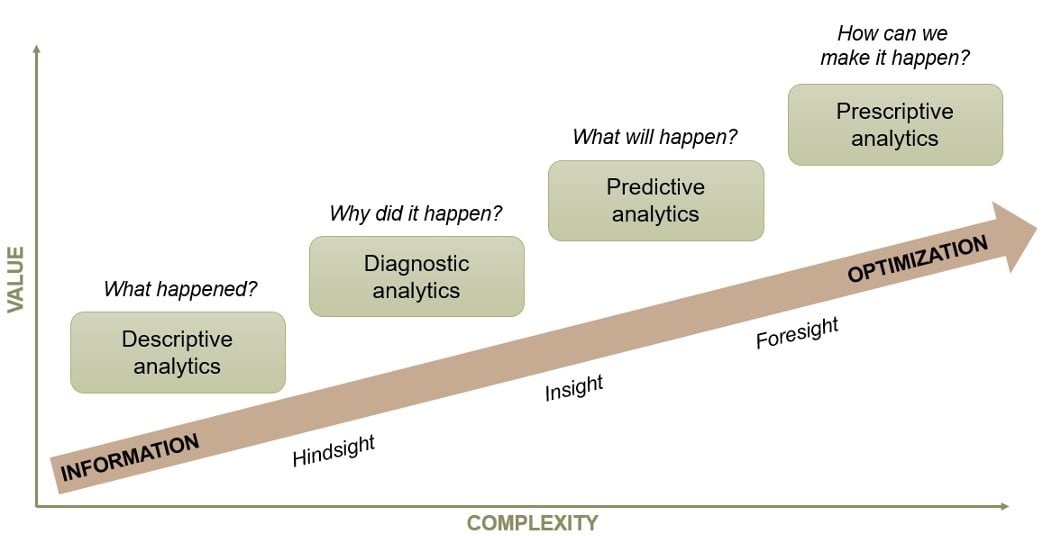 Gartner Analytic Ascendancy Model
The foundation question
This shift is already underway in leading data organizations. The question for data leaders isn’t whether it will happen, it’s whether the foundation is ready to support it safely.
Three things matter most:
- Semantic layer and ontologies. AI is only as trustworthy as the definitions underneath it. “Revenue,” “active customer,” and “churn” can mean different things across different parts of the business, and without clear definitions, AI can produce answers that are technically correct, but contextually wrong. Solid data models, shared semantic layers, and clear and consistent ontologies are what makes AI answers reliable, rather than confident-sounding guesses.
- A governed platform. When more people reach data in more ways, governance becomes even more important. Security, access control, and traceability need to scale beyond a small analyst team. In an AI-driven environment, governance is not a constraint, but rather an enabler for widespread use of data without losing trust or control.
- Human capabilities: The third pillar is human. Users need to understand both how to get answers using AI, as well as when to trust them and when to question them. This requires a combination of data literacy, AI literacy, and the ability to ask precise and contextualized questions. Without that, even a well-governed platform can produce false confidence. This is as much a cultural investment as a technical one.
Where we are
Twoday has spent years building data platforms, analytics solutions, and delivering insights to businesses. The shift described here is beginning to show up in real client environments — not everywhere, not all at once, but unmistakably. We’re investing in being ready for it, and we’re here to help our clients ask the right questions to prepare for this shift.
The reports will not disappear. But how we reach our data is changing and expanding. Organizations that choose to build the right foundation now will be the ones that can move with confidence when the shift accelerates.