
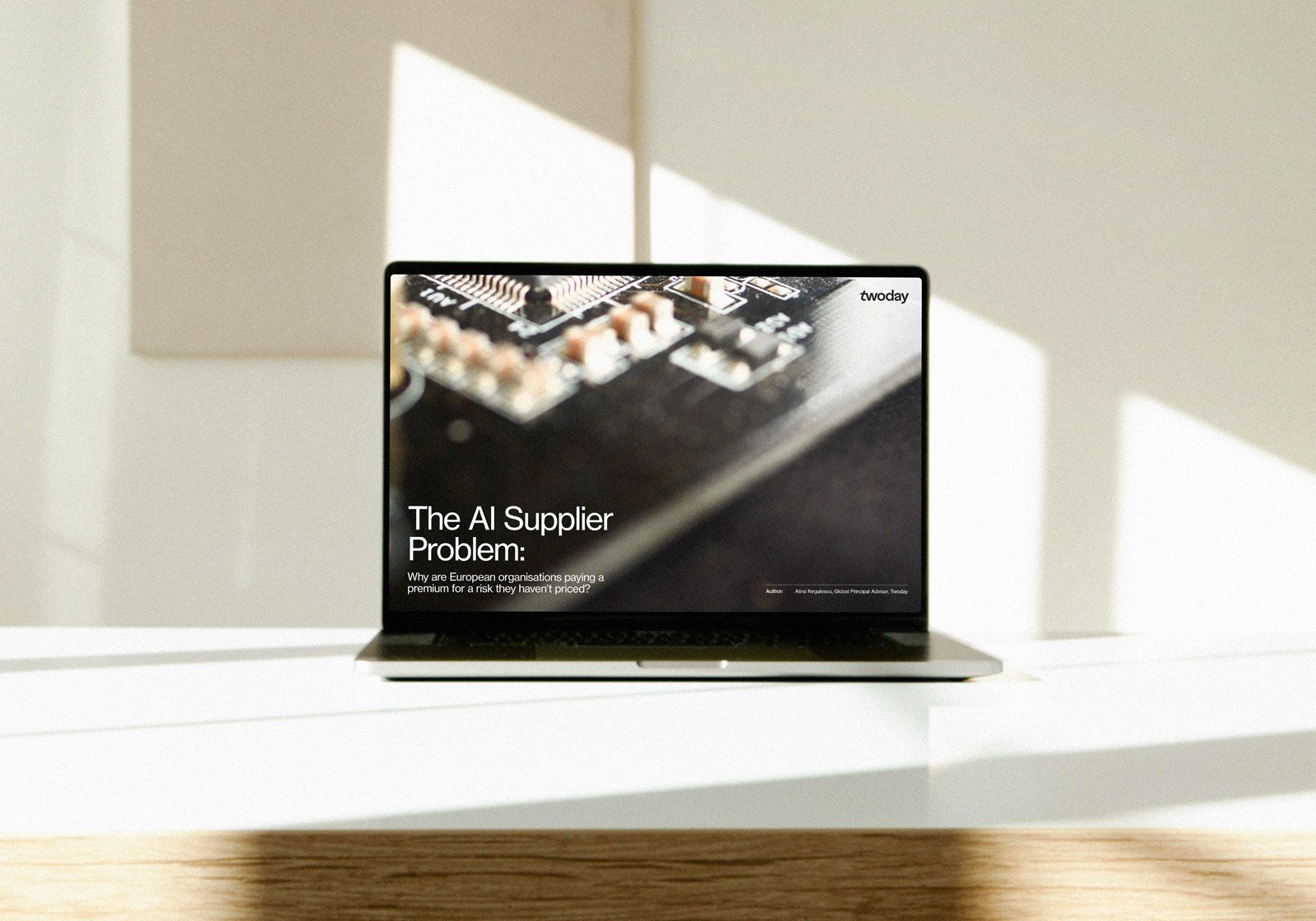
AI adoption is accelerating across European organisations. New use cases are deployed at speed, and AI is becoming a core part of business operations.
But while organisations are moving fast to adopt AI, many are overlooking a critical question:
Do we actually have a strategy for our AI suppliers?
This rapid adoption often happens without a clear strategy for suppliers. Organisations rely heavily on a small number of global providers, which enables speed – but also creates a growing dependency that is rarely questioned.
Paying a premium for unpriced risk
As this dependency increases, so does exposure to risk. Many organisations are not only consuming AI capabilities; they are also taking on commercial, compliance, and flexibility risks they have not fully assessed.
In practice, this means that organisations may be paying a premium for risks they have not properly identified or priced.
The core issue is not a lack of available technology. For many enterprise use cases, viable alternatives already exist.
The real challenge lies in how organisations approach AI sourcing. Decisions are often made tactically, rather than strategically, with limited focus on long-term flexibility or supplier diversity.
Not a technology gap, but a strategy gap
The core issue is not a lack of available technology. For many enterprise use cases, viable alternatives already exist.
The real challenge lies in how organisations approach AI sourcing. Decisions are often made tactically, rather than strategically, with limited focus on long-term flexibility or supplier diversity.
Explore the full perspective
This is the core of what we call the AI supplier problem.
In the full whitepaper, we explore why supplier concentration is a business risk, how AI sourcing is changing, and what organisations can do to reduce lock-in and build a more flexible AI strategy.
Go to the The AI Supplier Problem whitepaper