
.jpg?width=3910&height=2603&name=pexels-scottwebb-136739%20(1).jpg)
As legacy applications transition from monolithic architectures to microservices, one of the most challenging phases is the hybrid state. In this phase, a monolith and one or more microservices coexist and share responsibility for the same features or data.
This article presents a practical testing strategy for hybrid monolithic–microservice systems, covering both manual and automation approaches based on real-world experience.
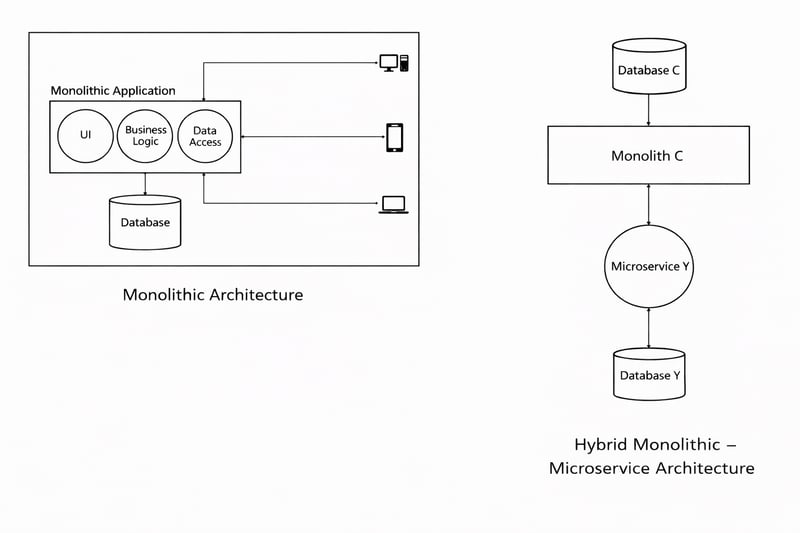 From a traditional Monolith to a hybrid Monolithic–Microservice architecture
Manual testing
Manual testing remains critical in hybrid environments, especially when new functionality is introduced gradually and controlled through feature toggles. In these systems, behavior can change depending on configuration, rollout state, and data consistency, making exploratory and scenario-based testing essential.
Feature toggles and rollout testing
Feature toggles are commonly used to control the rollout of new microservice functionality. In many cases, more than one toggle is required to safely manage the transition.
Typically, two types of toggles are involved:
- Technical toggle: manages data synchronization and integration between the monolith and the microservice. This toggle is usually enabled first and is often one-way.
- Functional toggle: controls whether new functionality is exposed to end users when it is released together with the microservice implementation.
If no end-user functionality is introduced, only the technical toggle is usually required.
One-way toggles and data risks
When a toggle is one-way, disabling it can lead to serious data inconsistency or corruption.
For example, when a technical toggle is enabled, the system may synchronize and read data from two sources: one table in the monolith database and another in the microservice database. In many real scenarios, the microservice stores more detailed or time-based data, while the monolith stores only the current value.
In one real implementation, the microservice stored historical and future values with defined time ranges, while the monolith stored only the current value and relied on the microservice to resolve the correct value based on time.
If such a toggle is disabled, the system reverts to reading and updating data only from the monolith database. The most common consequences are:
-
Time ranges, historical data, and future values are no longer supported.
-
Existing client data configured with time ranges becomes invalid.
-
Re-enabling the toggle later can overwrite microservice data during a new synchronization from the monolith, resulting in permanent data loss.
To prevent this, clear safeguards must be implemented. Disabling one-way toggles should either be technically blocked or explicitly discouraged through documentation. Testers must verify that these protections are in place.
Two-way toggle scenarios
When two-way toggles are used, all toggle states and transitions must be tested carefully.
Key scenarios include:
- Enabling the toggle for selected clients: should correctly activate microservice behavior, including the initial data rollout and data synchronization when the toggle is enabled for the first time.
- Disabling the toggle: must cleanly revert behavior to the monolith, ensuring that correct data from the monolith is presented while microservice data remains stored without modification.
- Re-enabling the toggle: must work smoothly and reliably, even after multiple toggle changes. Depending on the requirements, either monolith data should override microservice data or previously created microservice data should be synchronized back to the monolith.
Initial data migration
When a microservice introduces its own database, testers must verify initial data migration through scenarios that trigger data reads from both the monolith and the microservice.
The first activation of the technical toggle typically initiates the initial data migration. Once this process completes, regression testing is required across all affected areas. The goal is to ensure that end-user behavior remains unchanged, existing functionality continues to work correctly, and data sources remain consistent after migration.
Data synchronization
After the initial migration, the system enters a hybrid state where both the monolith and the microservice read from and write to their respective databases. This means the same data exists in two places.
Manual testing should focus on verifying synchronization accuracy. Recommended checks include:
- Performing create, update, and delete actions in the UI and verifying that results are reflected correctly in both systems.
- Exploring edge cases that may trigger partial updates or failures, such as imports, file uploads, or batch operations.
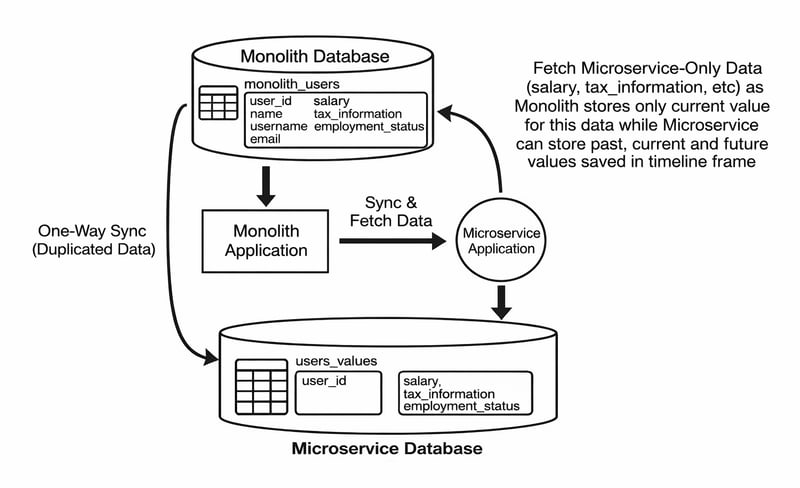 Initial Data migration and synchronization
Microservice API endpoints
If the microservice exposes API endpoints that bypass the monolith, additional test coverage is required.
This includes:
- Direct interaction testing: reading and writing data through microservice endpoints and verifying correct synchronization across systems.
- Access control validation: ensuring clients without the appropriate feature toggle cannot use these endpoints. Proper error responses such as 403 Forbidden or 404 Not Found must be returned, depending on design decisions.
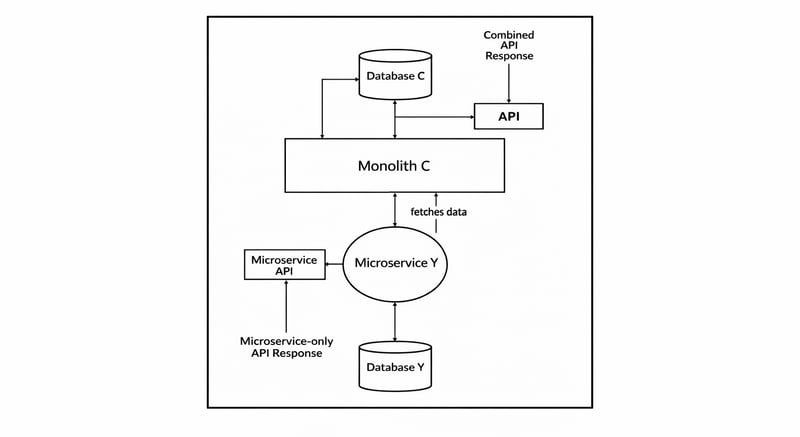
Automation testing
Automation is essential for maintaining reliable regression coverage, but hybrid architectures introduce constraints that require careful planning around where and how tests are executed.
Microservice functionality coverage
A common question is whether it makes sense to run automation tests locally when microservices expose no UI.
In local environments, the monolith UI may be available, but microservice behavior often has to be mocked. While mocking enables limited testing, it undermines the purpose of end-to-end automation, which should validate real behavior using real data. For this reason, automating microservice-related scenarios in local environments is usually not worth the effort.
Instead, microservice-related automation should be executed in test or staging environments where both systems are deployed. This allows testers to validate microservice functionality and the full integration between systems, including API communication, data processing, synchronization, and cross-system interactions.
Tests should be executed only when these environments are stable. High load or instability can significantly increase false-positive results.
Monolith-only functionality coverage
Local environments remain valuable for automating monolith-specific scenarios. Tests covering legacy functionality and internal flows unaffected by microservice changes should continue to be automated and executed locally, ensuring fast feedback while minimizing external dependencies.
Final thoughts and best practices
Hybrid monolithic–microservice architectures evolve over multiple iterations. After the initial rollout, clients often begin using the system in production while further changes are still underway.
During this phase, data integrity and system stability must be carefully managed.
Best practices include:
- Implementing safety restrictions in code to prevent risky actions such as disabling one-way toggles
These requirements should be included in sprint scope and clearly documented - Assigning clear ownership within the development team to enforce these safeguards
- Communicating clearly with clients about which actions are allowed or potentially dangerous during the hybrid phase. If changes are purely technical, users should not notice behavioral differences. If functionality changes are introduced, expectations must be clearly communicated.
- Validating not only new features, but also cross-system impact and integrations
When testing hybrid monolithic–microservice systems, automation ensures consistency, while a well-planned manual testing strategy addresses the complexities of synchronization, toggles, migrations, and live production scenarios.