

In October 2025, Gartner published the first Magic Quadrant for Business Orchestration and Automation Technologies (BOAT), formally establishing BOAT as a distinct enterprise technology.
In the report, vendors are evaluated based on Ability to execute and Completeness of vision. However, the real significance of BOAT is not the vendor landscape itself. It is what BOAT represents: a fundamental shift from fragmented automation initiatives toward end-to-end orchestration of business outcomes. This marks an evolution from improving individual processes to redesigning how the enterprise operates as a whole.
From process optimization to business orchestration
For decades, organizations have pursued efficiency through process optimization. Automation initiatives typically focused on areas such as:
- Robotic Process Automation (RPA) in finance and operations
- Workflow automation in HR and customer service
- Integration platforms (iPaaS) in IT
- AI pilots isolated in innovation or data teams
While these initiatives delivered local productivity gains, they rarely changed how the business functioned end-to-end. The result has been fragmented automation, growing architectural complexity, and limited visibility into how value is created across the enterprise.
BOAT addresses this challenge by shifting the focus from optimizing individual processes to orchestrating complete value streams. Instead of asking, “How do we automate this task?”, organizations begin asking:
“How do we orchestrate processes, people, systems, and AI to consistently deliver the desired business outcome?”
BOAT as a business and operating model, not just a technology stack
What makes BOAT strategically important is that it directly connects technology to the business operating model.
A BOAT-enabled organization:
- Designs its business around orchestrated, end-to-end value streams
- Embeds automation and AI into daily operations
- Builds governance, transparency, and compliance into workflows by design
This allows organizations to adapt to new products, markets, partners, or regulatory requirements through orchestration rather than large-scale system replacements.
In this sense, BOAT is not simply an automation platform. It becomes the execution layer of the business model itself.
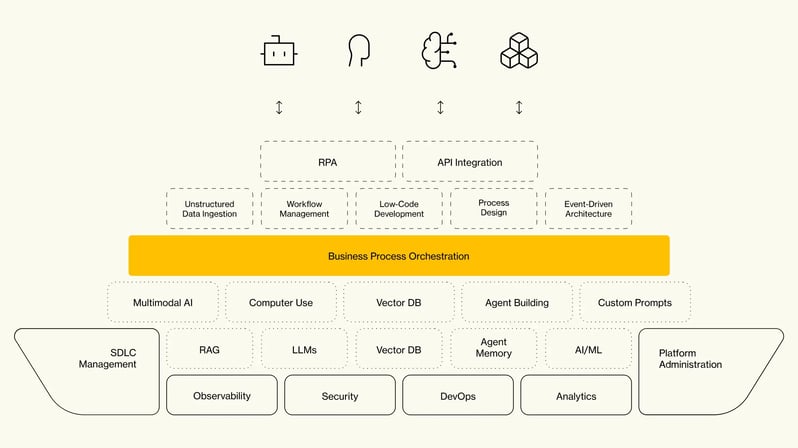
Agentic AI needs orchestration and orchestration enables AI at scale
Much of today’s AI discussion focuses on copilots, large language models, and autonomous agents. Without orchestration, however, agentic AI introduces significant risks: lack of transparency, poor scalability, governance challenges, and compliance concerns.
BOAT provides the missing foundation by embedding agentic AI within orchestrated, auditable workflows, where:
- Humans and AI-agents collaborate in structured way[KK1] s
- Decisions are made with full business context
- Actions can be monitored, overridden, or adapted in real time
As a result, AI shifts from isolated experimentation to a reliable operational capability.
Why BOAT is inevitable for modern enterprises
BOAT is not a passing trend. It is a response to three structural realities:
1. Business change outpaces system change
Markets and customer expectations evolve faster than traditional enterprise systems. BOAT introduces an orchestration layer that enables adaptation without constant system rewrites.
2. Complexity is inherently cross-functional
Customer journeys, supply chains, and compliance obligations span departments and platforms. Orchestration, not additional point solutions, is required to manage this complexity effectively.
3. AI demands enterprise-grade governance
Without orchestration, AI either becomes chaotic or overly constrained. BOAT enables scalable governance while preserving the flexibility that makes AI valuable in the first place.
From “digital transformation” to “coordinated business orchestration”
Many organizations have undergone multiple waves of digital transformation implementing ERP systems, CRM platforms, RPA tools, integration layers, and more recently generative AI. Yet in many cases, these investments have resulted in fragmented automation rather than coordinated execution across the enterprise and without fundamentally changing how work is organized and executed.
Rather than treating automation as isolated tooling initiatives, BOAT platforms are positioned as enabling:
- End-to-end orchestration of business processes
- Coordination across systems and applications
- Management of multi-agent, cross-functional workflows
- Governance and visibility across automation initiatives
This is why Gartner positions BOAT not merely as a tooling category, but as a strategic enterprise capability with a unifying enterprise layer for business orchestration and automation, as reflected in the Magic Quadrant and associated market guides.
The future belongs to orchestrators
The next generation of leading organizations will not be defined by how many tasks they automate, but by how effectively they orchestrate:
- End-to-end value creation
- Human and AI collaboration
- AI-driven decision-making at scale
BOAT is the architectural and operational foundation that enables this shift. It is not just the future of automation. It is the future of how businesses are designed and evolved.